
Our Blog | EV Charging Innovation
The Race to Higher-Power EV Charging Is On. But Power Alone Isn't the Answer.
EV Charging Innovation | 11/3/2026

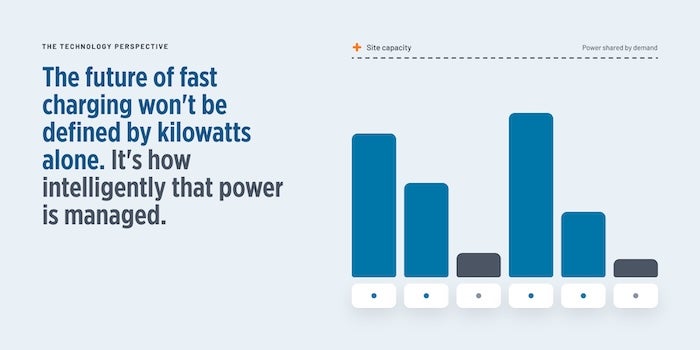
As ultra-fast charging technology advances, the industry's next challenge is delivering more power intelligently, efficiently and at scale.
The electric vehicle industry has entered an era where charging power is becoming an increasingly important measure of technological progress. Vehicles are capable of accepting higher charging rates. Charging equipment is becoming more powerful. And the expectations surrounding how quickly drivers should be able to recharge are continuing to evolve. The latest industry research confirms that this transition is already underway.
According to Paren's Q3 2026 State of the EV Charging Industry report, 35% of newly deployed non-Tesla DC fast-charging ports in the United States were rated at 400 kW or higher. It's a significant indicator of where the market is heading.
But as the industry moves toward higher-power charging, we need to recognize an important distinction: Delivering more power is not the same as delivering a better charging experience. The future of EV charging will depend on how intelligently we manage that power.
The Shift Toward Higher-Power Charging
Higher-power charging infrastructure represents an important advancement for electric mobility. For drivers, the potential benefits are clear: shorter charging stops, greater convenience and charging experiences that more closely align with the expectations established by traditional fueling.
For commercial operators, higher-power charging can create opportunities to serve more vehicles and support applications where charging time directly affects operational productivity. This is particularly relevant for high-traffic retail locations, highway corridors, fleet operations and other environments where vehicle throughput matters.
However, higher charging power introduces additional complexity. A charging station capable of delivering 400, 500 or 600 kW requires more than powerful equipment. It requires careful consideration of electrical infrastructure, site capacity, energy availability, thermal management and the capabilities of the vehicles using it.
More importantly, a charger's maximum rated power does not mean every vehicle will charge at that rate. Actual charging performance depends on several factors, including battery chemistry, state of charge, battery temperature and vehicle charging architecture.
As a result, higher-power charging should be evaluated not simply by its maximum output, but by the value it delivers across real-world charging sessions.
The Grid Is Part of the Equation
One of the most significant challenges facing higher-power charging is the electrical infrastructure required to support it. Installing high-power chargers can place substantial demands on a site's available electrical capacity.
Depending on the location, supporting additional charging power may require utility coordination, electrical service upgrades, transformer capacity or other infrastructure investments. These requirements can influence project cost, deployment timelines and long-term operating economics.
For site operators, the question is not simply how much power a charger can deliver. It's how much power the site can support, when that power is needed and how to use it most effectively. This is where intelligent energy management becomes essential.
Rather than treating each charger as an isolated piece of equipment, charging infrastructure increasingly needs to operate as part of a coordinated energy system. Dynamic power allocation, load management and intelligent scheduling can help operators distribute available capacity according to charging demand and site constraints.
In some applications, these capabilities may help reduce the need for electrical upgrades or improve the use of existing infrastructure. The goal is not necessarily to deliver maximum power at every moment. It's to deliver the appropriate amount of power when and where it creates the most value.
Why Software Is Becoming as Important as Hardware
As charging technology advances, software is becoming central to the performance and economics of charging infrastructure. Consider a location with multiple high-power chargers.
Charging demand may vary significantly throughout the day. Some vehicles may be capable of accepting high charging rates, while others may be limited by their battery systems or current state of charge. Without intelligent coordination, a site may be unable to use its available electrical capacity efficiently.
Software can help address this challenge by monitoring charging activity, allocating power dynamically and providing operators with visibility into performance. It can also help identify equipment issues, support remote diagnostics and provide data that informs maintenance and operational decisions.
Over time, the combination of charging data, energy management and predictive analytics has the potential to make infrastructure more responsive to real-world conditions. This is particularly important as charging networks become larger and more complex.
The industry's next technology breakthrough may not be a charger with a higher number on its specification sheet. It may be the intelligence that enables charging infrastructure to operate more efficiently.
Different Markets Require Different Solutions
Paren's research also highlights an important difference between the United States and Canada. While 35% of new non-Tesla U.S. fast-charging ports were rated at 400 kW or higher during Q3 2026, just 2% of all newly deployed Canadian fast-charging ports reached that threshold.
These figures represent different operator groups, so they are not directly equivalent. Nevertheless, they illustrate how deployment patterns can vary significantly between markets. Infrastructure requirements are shaped by vehicle adoption, travel patterns, grid conditions, site economics and local market needs.
A charging strategy designed for a busy interstate corridor may not be appropriate for a suburban retail location or a rural community. Similarly, the power requirements of a passenger vehicle charging site may differ substantially from those of a commercial fleet depot.
The future of charging infrastructure cannot depend on a one-size-fits-all approach. It requires flexible technology that can adapt to different environments and scale as demand changes.
That means thinking carefully about modularity, interoperability, energy management and the ability to support evolving vehicle capabilities.
Designing for Performance, Not Just Peak Power
The movement toward higher-power charging creates an opportunity to rethink how the industry measures charging performance. Maximum power output is an important technical specification, but it should not be the only one.
For drivers, what matters is the time required to receive the energy they need. For site operators, what matters is the ability to serve vehicles reliably while managing infrastructure and energy costs. For the broader energy ecosystem, what matters is how charging demand can be integrated efficiently with available electrical capacity.
These priorities are interconnected. A well-designed charging system must balance charging speed, energy efficiency, equipment reliability, site economics and the driver experience. Achieving that balance requires an integrated approach to hardware, software and energy management.
The opportunity for the industry is to move beyond simply building more powerful chargers and toward developing smarter charging systems.
The Future Is Intelligent Power
The transition to higher-power EV charging is an important step forward. It reflects the evolution of vehicle technology and the growing expectations of drivers and businesses.
But the industry's long-term success will not be determined by maximum charging power alone. It will depend on our ability to deliver that power reliably, manage it efficiently and make charging infrastructure economically sustainable at scale. That requires continued innovation in charging hardware, software, power electronics and energy management. It also requires a shift in how we think about charging infrastructure: not as individual devices delivering electricity, but as intelligent systems operating within a larger energy ecosystem.
The future of fast charging won't be defined by kilowatts alone. It will be defined by how intelligently we deliver and manage that power.
Source: Paren, State of the EV Charging Industry, Q3 2026, United States and Canada. Power-level comparisons reflect the respective operator groups reported by Paren.


