Our Blog | EV Charging Innovation
Why DC Charging Is Faster: A Simple Explanation
EV Charging Innovation | 7/7/2026

In our last post, we broke down AC charging speed with a handy formula: the station delivers power at a fixed amperage, the car's onboard charger handles the conversion, and you can predict charge time with reasonable confidence. DC fast charging? Not so simple. But once you understand the “why,” you’ll be far better equipped to set honest expectations with drivers, stakeholders, and customers — which is ultimately what matters most for your site.
Why DC charging is faster
DC stations bypass the vehicle’s onboard charger completely and deliver current directly to the battery, which is why DC charging is dramatically faster than AC. And because the station’s converters don’t need to fit inside a vehicle, they can be far more powerful.
Compare that to AC stations, where the car itself converts the incoming alternating current into the direct current that its batteries actually store. Every EV has a built-in on-board charger, which contains a rectifier that handles this conversion. The catch: that component has limits. Making it bigger and more powerful means making it heavier and more complex — and it still has to move around inside the vehicle. So, AC charging is typically limited to what the vehicle’s on-board charger can handle (commonly up to 48 or 80A in North America).
DC charging is simple in theory. But here’s where it gets more involved.
The charging curve: why DC speed isn’t a fixed number
To understand why DC speed isn’t a fixed number, start with this equation:
Voltage × Amperage = Kilowatts
Kilowatts measure the rate of power flowing into the battery. The higher the kilowatts flowing into the battery, the faster the charge. Everything else is just figuring out what determines voltage and amperage — and that’s where DC charging gets interesting.
With AC charging, the kilowatt output is essentially fixed. The station’s amperage is set, the voltage coming in from the grid is consistent, and the math is predictable.
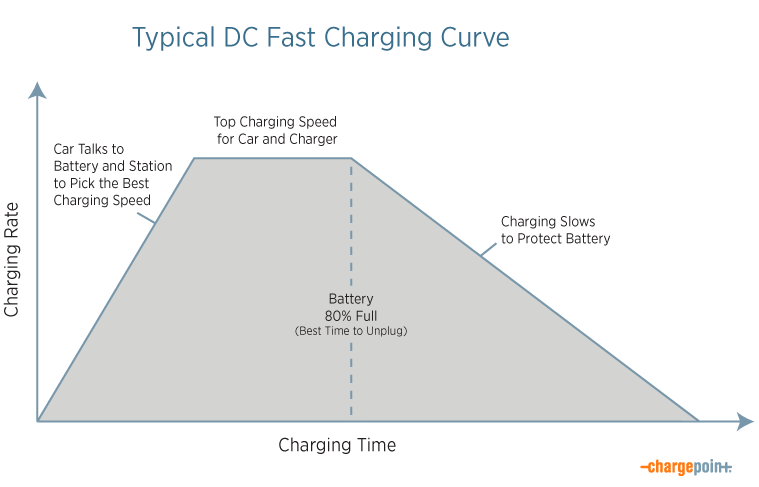
With DC, both voltage and amperage move throughout the charging session. This is called the charging curve, and it’s why you can’t describe a DC charge rate with a single number the way you can with AC.
Here’s what’s happening under the hood:
Voltage, the electrical pressure that pushes energy into the battery, is determined by the vehicle’s battery pack. Think of a battery pack like a long chain of individual cells connected in series, each one adding voltage to the total. A 400-volt vehicle architecture has cells adding up to 400 volts. But that number isn’t fixed during charging. When voltage rises in the session, the potential kilowatt charging power rises too, helping deliver higher speeds. As the battery fills, the voltage climbs — typically ranging from around 300 volts at a low state of charge up to 450 volts when nearly full. Newer 800-volt architectures follow the same principle at twice the scale.
Amperage, the amount of current flowing into the battery, is set by the vehicle’s computer and the cable. The car’s battery management system (BMS) is constantly deciding how much current to accept, based on temperature, state of charge, and battery health — all factors that affect safety and longevity. Heat is a good example: hot batteries can risk accelerated wear and degradation. Both external weather and fast charging itself can impact the temperature, so the BMS adjusts the amperage to keep the battery in a safe operating window. The charging cable has its own rated limit, too. So, amperage isn’t just about what the station can deliver; it’s a negotiated handshake between the station, the cable, and the car.
The result: charging speed on DC is always in motion. It typically peaks early in the session and tapers as the battery approaches full. That’s expected behavior, not a malfunction.
What this means for you as a station owner
When drivers ask “how long will this take?” the honest answer is: it depends on the vehicle. Charge time is shaped by the car’s battery architecture, its current state of charge, and how its software manages the charging session — not just the power rating on your station.
Your station delivers up to its rated maximum. The vehicle determines how much of that power it’s willing to accept at any given moment.
Understanding this distinction helps you have more confident, accurate conversations with drivers instead of overpromising on charge times that vary by vehicle.
Want to learn more about DC charging options for your site? Our team can walk you through station specifications, power capacity planning, and driver experience considerations.