Our Blog | EV Charging Innovation
Why ChargePoint Express Has the Best DC Fast Charger Architecture
EV Charging Innovation | 6/9/2026

Most DC fast chargers today are still built with the mindset of traditional battery chargers, where the AC input stage and DC output stage are combined into a single unit. This is the same architecture used in onboard vehicle chargers and many early EV fast‑charging systems. To achieve higher power levels, these all‑in‑one modules are simply paralleled, resulting in charger designs centered around large, monolithic power blocks. These systems often rely on liquid‑cooling loops to remove the excess heat generated by low‑efficiency power electronics’ switching devices. Thermal management is critical, as maintaining the temperature is necessary to preserve the product life, and more specifically the cycle life of the power electronics.
However, a liquid cooled combined‑module architecture introduces significant limitations: reduced power density, more complex and numerous failure modes, dependence on centralized cooling systems that create single points of failure, limited configurability and increasingly difficult serviceability: issues that site operators are only now beginning to fully recognize. ChargePoint Express takes a fundamentally different approach. The first choice we made was to separate conversion modules for AC to DC and DC to DC, which is the right way to handle power. Some recently announced DC fast chargers have validated this architecture as the future, but most still use combined power modules. The old logic of fewer combined modules, and a simpler bill of materials is flawed.
AC-to-DC rectification and DC-to-DC conversion operate at different voltage levels with different thermal profiles, different failure modes and different optimization targets. Coupling them means you can't optimize either independently. Worse, when one stage fails, you lose both. ChargePoint Express separates the AC-to-DC conversion from the DC-to-DC conversion. Each stage is purpose-built and optimized for its specific job. Each module is independently designed, tested and validated. Thermal management is simpler: no more cooling two different heat profiles in one enclosure. Serviceability improves dramatically, meaning time to repair decreases, spare parts inventory gets cheaper and system uptime improves.
The advantages cascade further. Our Express architecture turns EV charging into a DC energy platform by allowing solar and batteries to plug directly into the charger’s DC power system without going through inefficient AC conversion steps. An internal DC bus becomes the single energy interchange layer for energy injection (solar, grid via AC modules) and energy storage (battery).
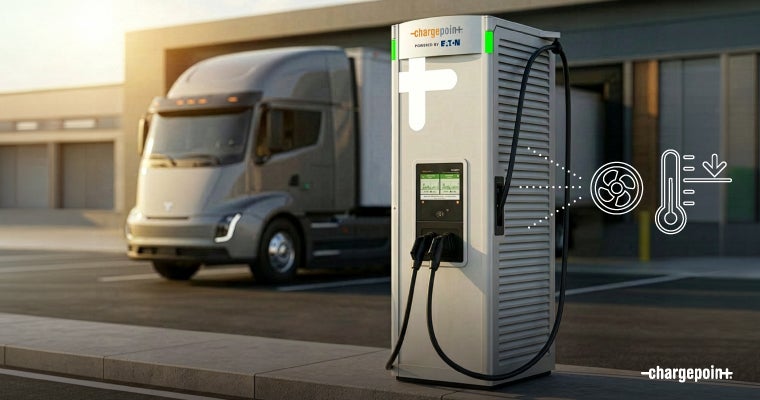
Our second key architectural choice was the approach to thermal management. We don’t subscribe to the myth that liquid cooling is the future. This assumption is so widespread it tells you how far marketing has outrun engineering excellence. Liquid cooling is a crutch for sub-par high power electronics design. It introduces a multitude of shortcomings including pumps with bearings that wear out, coolant that degrades and leaks, and seals and fittings that are each a potential failure point. When a liquid cooling system fails, it doesn't degrade gracefully, it’s catastrophic. Your power electronics hit thermal shutdown within minutes and the entire charger goes down. What’s even worse, accommodating the space required for liquid cooling systems makes the product larger, which is exactly what you don’t want. ChargePoint Express uses air cooling not because it is easier, but because the architecture is fundamentally better. When we say it’s not easy to provide great product lifetime with air cooling, that’s an understatement. How we solved it represents some of the most significant technological innovation that makes our Express architecture possible. Co-innovating with one of the world’s leading silicon carbide suppliers (SiC is a semiconductor that enables dramatically more efficient, higher-voltage and higher-temperature power electronics), we eliminated two of the most prevalent problems with SiC Power Modules: increasing operating temperatures and short lifetimes. Our power electronics can run hotter and for longer without damaging the power semiconductors at levels of performance not seen in the EV charger use case. This decreases the reliance on extensive thermal management. As a result, the product is more efficient, smaller, costs less, an entire category of failure modes are eliminated, it’s simpler to manufacture, easier and less expensive to install and service, and is fundamentally more reliable over a 10- to 15-year deployment life.
What these architectural choices lead to is one of the most important metrics for a DC fast charger: areal energy density, which is the power you can deliver per unit of ground area your equipment occupies. Real estate isn't free. Every extra square meter of space matters. It's not just an engineering metric; it's a business metric. As a result of our architectural choices, ChargePoint Express delivers superior areal energy density. At over 70kW/square feet, it’s the highest areal energy density charger available. More kilowatts in less ground space means operators can deploy more capacity in the same footprint or free up real estate for other uses. This is about making EV charging economics work at scale, and areal energy density is a compound advantage. It doesn't just save space today; it provides room to grow tomorrow. When demand increases, sites are not constrained by footprint decisions made years ago.
ChargePoint Express is the only DC charger that nails the key architectural choices: separated conversion modules for independent optimization and direct solar and battery integration, air cooling for long-term reliability and lowest TCO, and maximum areal energy density for better site design flexibility and economics.
Architectural decisions made today will determine which platforms survive and which get ripped out in five years. Get the architecture right, and everything else follows. ChargePoint Express got the architecture right.